Burkarder Tor
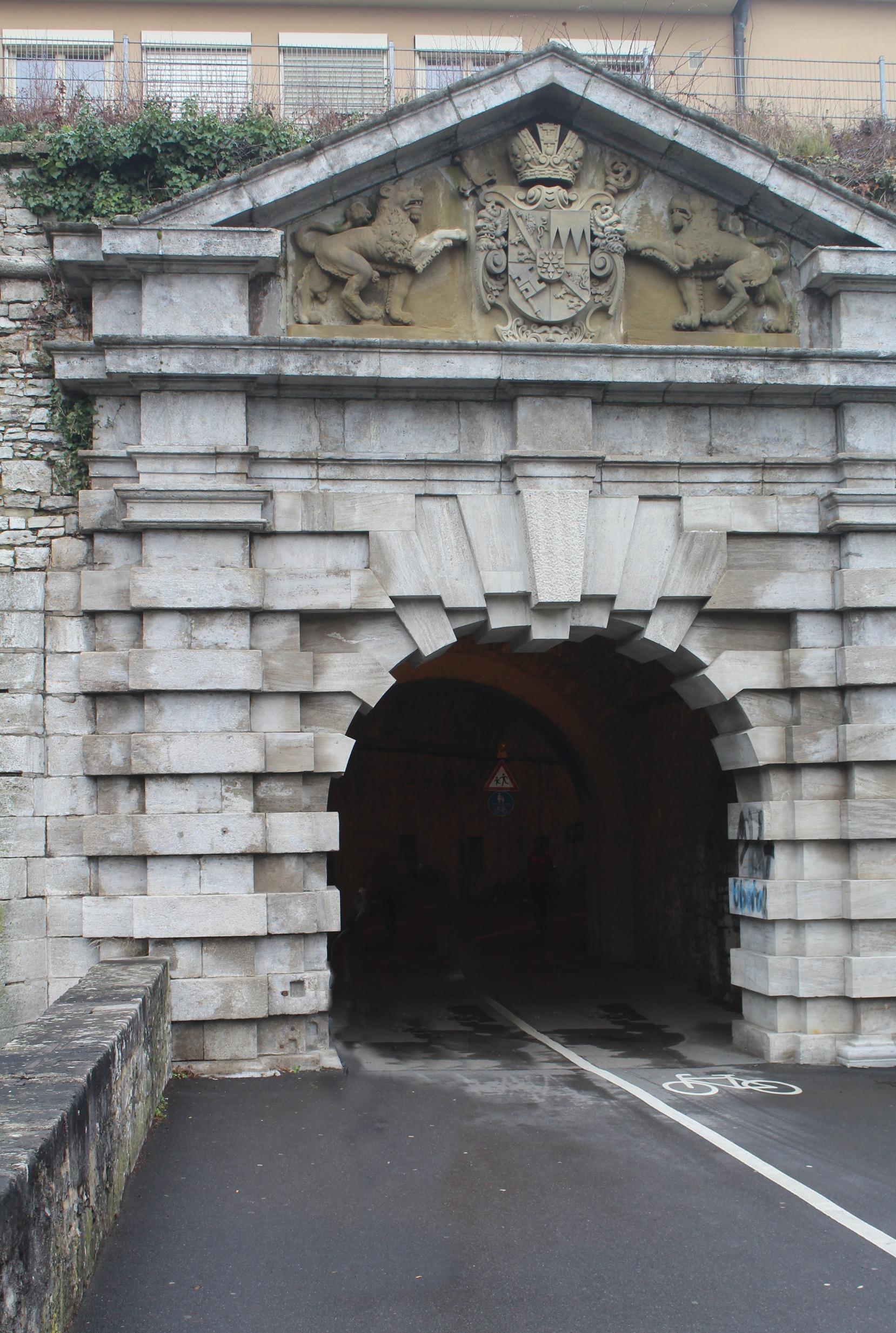
Burkarder Tor stands in Würzburg, Germany, as a fortified gateway beside the former Burkarder Canal. Green space surrounds the stone bridge and its pond. Antonio Petrini built the gate in 1680 within Bastion Sankt Burkard, joining Italian Baroque with German Renaissance. Pedestrians and cyclists now pass through the surviving gateway.
Above the rusticated portal, two lions hold the coat of arms of Prince-Bishop Peter Philipp von Dernbach. Inside, the passage bends instead of running straight. That curve supported defence, while western loopholes, a side casemate, and a rampart stairway controlled movement around the fortifications. An eastern barred window conceals only a small blind room. Old photographs show a former portcullis house, although no guardhouse crowns the gable.
The wooden bridge became stone in 1757 and 1758, while its arches once allowed canal traffic beneath the crossing. The canal itself was filled around 1950. Bombing in 1945 destroyed the gate arches, but the southern bridge, pedestrian walkway, and keystone mask survived. Water lilies and goldfish now occupy the former canal. Near the old tunnel entrance, the surviving crossing connects Würzburg’s defensive past with its green riverside setting.
- City
- Würzburg
- Content updated
Take this page with you
The myTuur app is free, and once you are standing at a spot its story starts by itself.


Spots like this one are the stops myTuur strings into tours through Würzburg. In the app, each story begins where you stand: walk up to a spot and it starts, read it on screen or listen as you go, then follow the route to the next one.
What is myTuur?
myTuur is a free city-guide app. Its tours are built from spots, and each spot carries a story that starts when you get there, to read or to listen to as you like.