De Duif
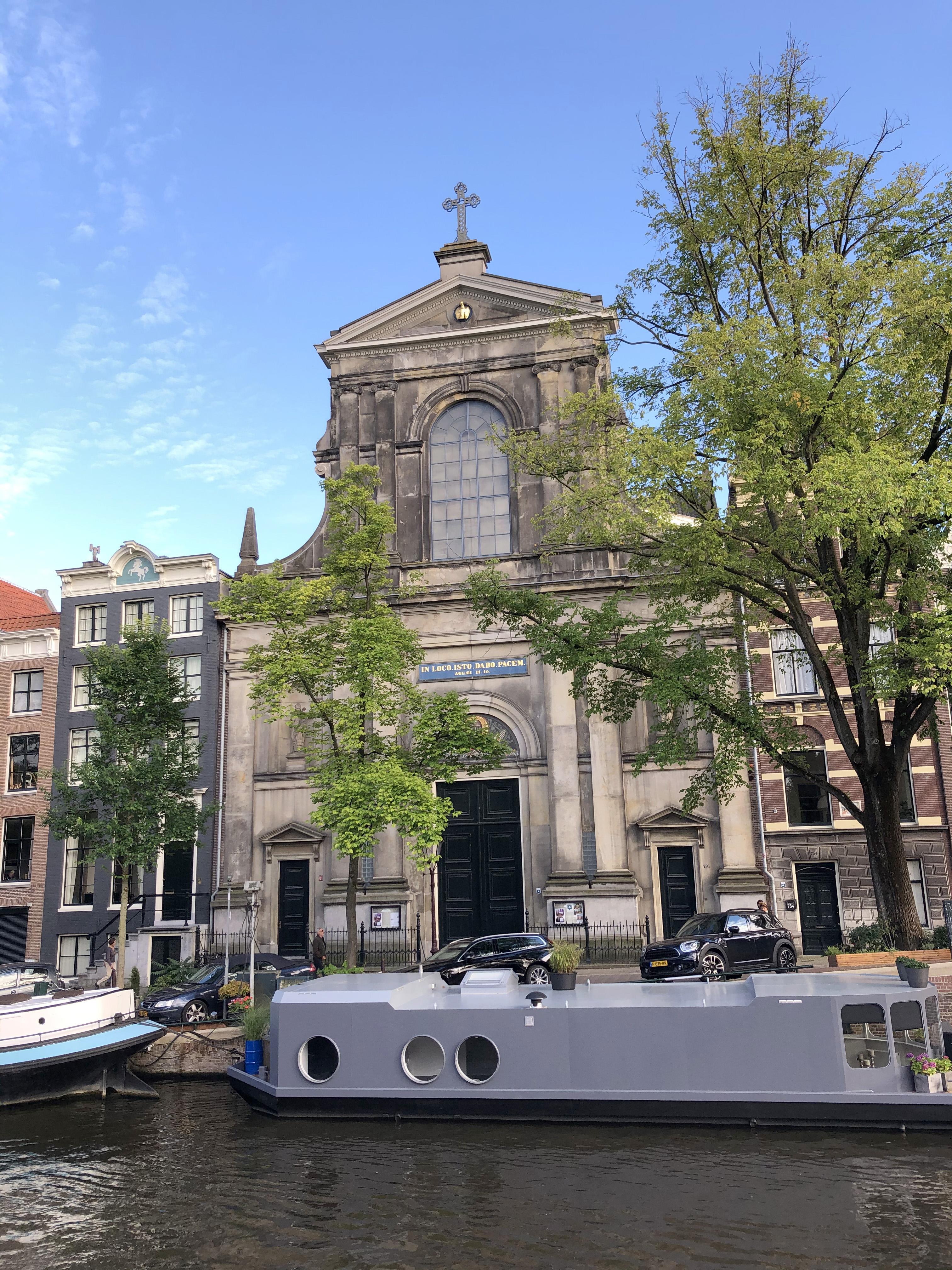
De Duif stands on Amsterdam’s Prinsengracht, a church with a modest façade between grand canal houses. Columns and symmetry mark Theo Molkenboer’s neo-classical design, while the front carries neo-Baroque details. Built in 1858 as the Roman Catholic St Willibrorduskerk, it now serves as an accessible architectural landmark. The spacious interior contrasts with its restrained street-facing appearance.
Its name recalls Het Vrededuifje, a hidden Catholic church that once stood on Kerkstraat. The present building replaced an earlier St Willibrordus church on the site of a burnt sugar factory. After the last Mass in 1974, parishioners occupied the building to help save it. Restoration uncovered original wall paintings beneath later layers of paint. As a national heritage site, it is managed by Stadsherstel Amsterdam. Since reopening in 2002, the church has hosted concerts, opera, dance, theatre, weddings and fairs.
Inside, the Smits organ forms a monument within the monument, built by Franciscus Cornelius Smits and his son. It is the largest organ built north of the major Dutch rivers. Look above the entrance for a dove restored with gold leaf in 2019. A Steinway grand piano once belonged to Russian pianist Youri Egorov.
- City
- Amsterdam
- Content updated
Take this page with you
The myTuur app is free, and once you are standing at a spot its story starts by itself.


Spots like this one are the stops myTuur strings into tours through Amsterdam. In the app, each story begins where you stand: walk up to a spot and it starts, read it on screen or listen as you go, then follow the route to the next one.
What is myTuur?
myTuur is a free city-guide app. Its tours are built from spots, and each spot carries a story that starts when you get there, to read or to listen to as you like.