Palazzo Belgioioso
Palazzo Belgioioso stands in Milan as a notable example of early neoclassical architecture. Giuseppe Piermarini designed the palace for Prince Alberico Belgioioso d’Este.
Construction took place from 1772 to 1781, placing the building within Milan’s late eighteenth-century architectural history. Its façade uses flat rustication and a continuous entablature. The composition separates its levels with severe orthogonality, creating a calm surface across the palace frontage. A central triangular pediment crowns the building.
Shallow joints in the ashlar stonework strengthen the façade’s almost two-dimensional effect. Regular windows and doors punctuate each level of the ashlar frontage. Inside, a colossal staircase displays classical stemmed vases. A columned gallery holds a fresco by Martin Knoller. The Tyrolean artist created the work in a German neoclassical manner.
Bernini’s influence appears in the design, while Piermarini shapes the building through restrained Milanese order. Palazzo Belgioioso belongs to Milan’s architectural landscape. Its form also records the relationship between the palace and Habsburg rule in Lombardy. The stone façade, pediment, gallery, and staircase make its design readable from outside and within.
- City
- Milan
- Content updated
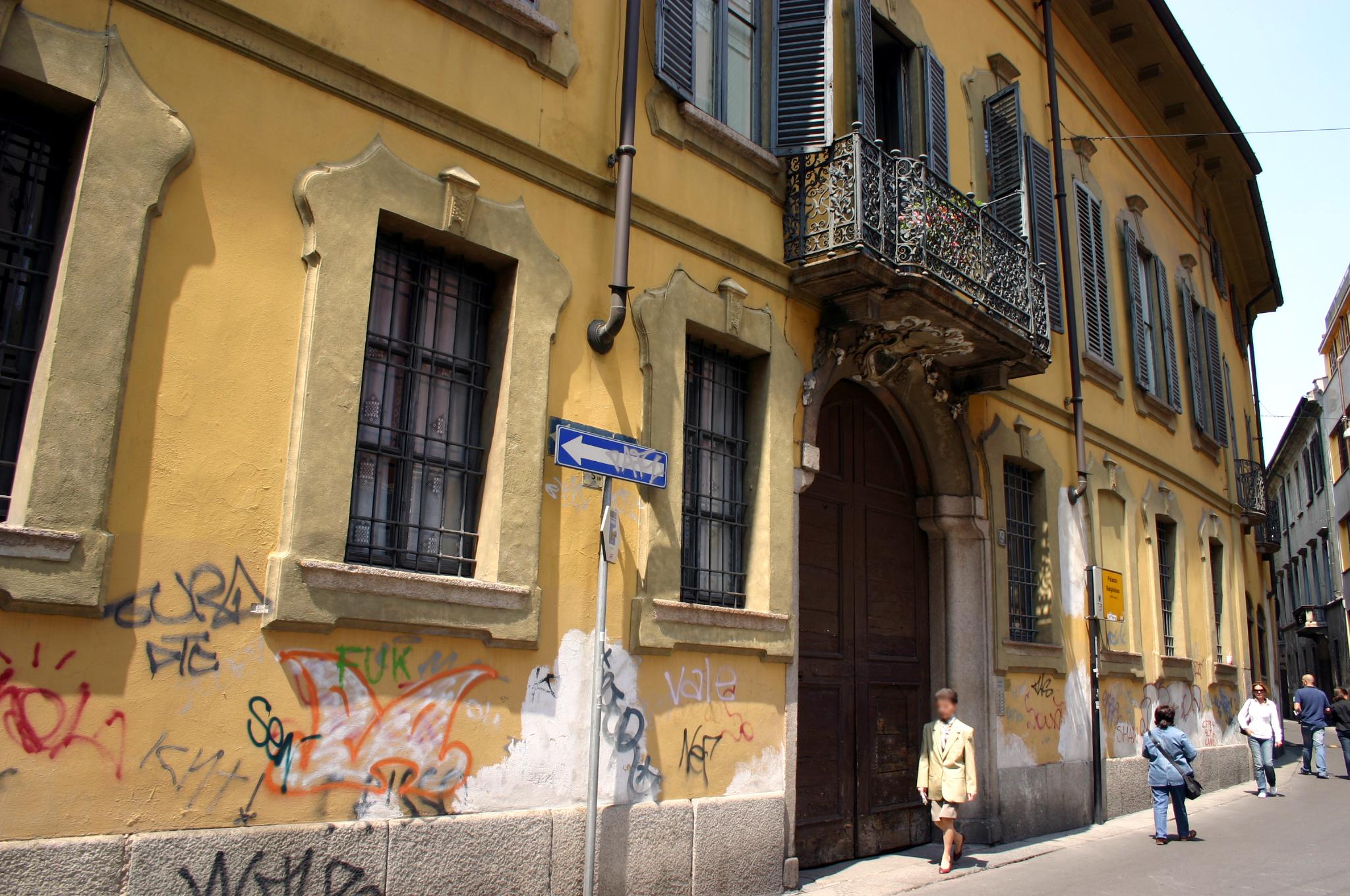
Image: G.dallortoAttribution
Take this page with you
The myTuur app is free, and once you are standing at a spot its story starts by itself.


Spots like this one are the stops myTuur strings into tours through Milan. In the app, each story begins where you stand: walk up to a spot and it starts, read it on screen or listen as you go, then follow the route to the next one.
What is myTuur?
myTuur is a free city-guide app. Its tours are built from spots, and each spot carries a story that starts when you get there, to read or to listen to as you like.