Kirche der barmherzigen Brüder zur unbefleckten Empfängnis Mariae
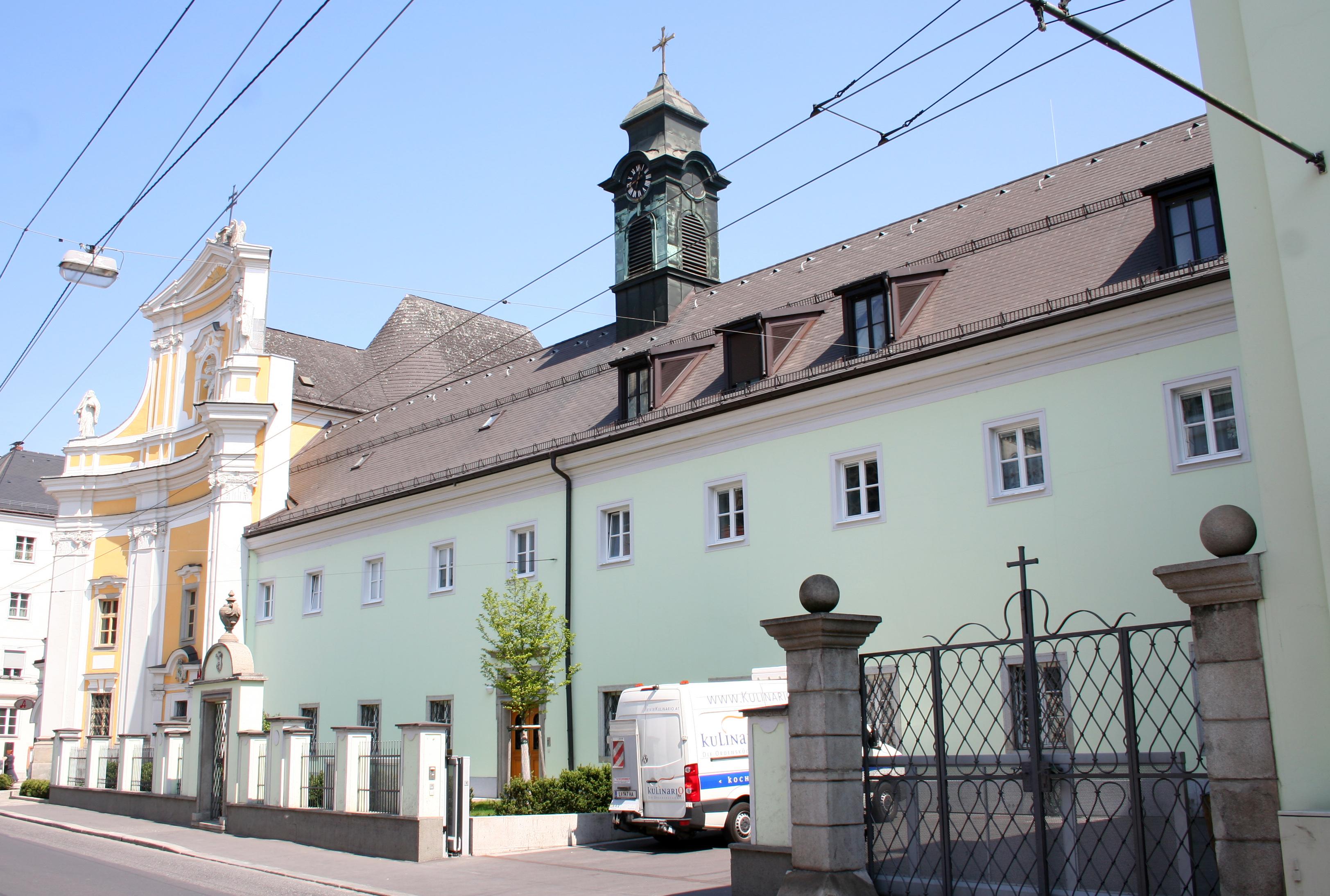
In Linz, Upper Austria, the Kirche der Barmherzigen Brüder zur Unbefleckten Empfängnis Mariae presents a concave, sweeping baroque façade to the Herrenstraße. The Brothers Hospitallers still run the hospital whose wing joins the church on its east side. A stone figure of Saint John of God, the order's founder, looks down from the curved gable. Above the portal sits the coat of arms: a pomegranate with a cross growing out of its opened fruit.
Carmelite nuns worshipped here first, in a convent founded from Vienna in 1710 with Empress Eleonore's support. The Linz master builder Johann Michael Pruner directed the work between 1713 and 1716. The church itself reached completion only in 1743. Emperor Joseph II dissolved the convent in 1782 and sold the church's inventory for the benefit of the religious fund. The high altar, with Martino Altomonte's painting of Saint Teresa of Ávila, moved to Frankenmarkt. Five years later, Joseph handed the monastery over to the order. The brothers had opened their first Linz hospital in 1757, and space shortages pushed them into the former convent in 1789. They care above all for the sick who cannot pay, and the hospital has grown with the city since the mid-eighteenth century.
Inside, a longitudinal oval hall lifts your gaze to the dome, where six lunettes break the curve. Johann Martin Schmidt, known as Kremser Schmidt, painted the high altar picture in 1773: the Immaculate Conception of Mary, the church's dedication. Above it, pomegranate stucco frames an oval fresco of God the Father with a sceptre and Archangel Michael with scales. Horatio Gaigher's 1916 altarpiece depicts Saint John of God washing a sick man who, legend says, is Christ himself. The church holds regular services in Polish, Czech and Slovenian, reflecting the diverse community that gathers here.
- City
- Linz
- Content updated
Take this page with you
The myTuur app is free, and once you are standing at a spot its story starts by itself.


Spots like this one are the stops myTuur strings into tours through Linz. In the app, each story begins where you stand: walk up to a spot and it starts, read it on screen or listen as you go, then follow the route to the next one.
What is myTuur?
myTuur is a free city-guide app. Its tours are built from spots, and each spot carries a story that starts when you get there, to read or to listen to as you like.