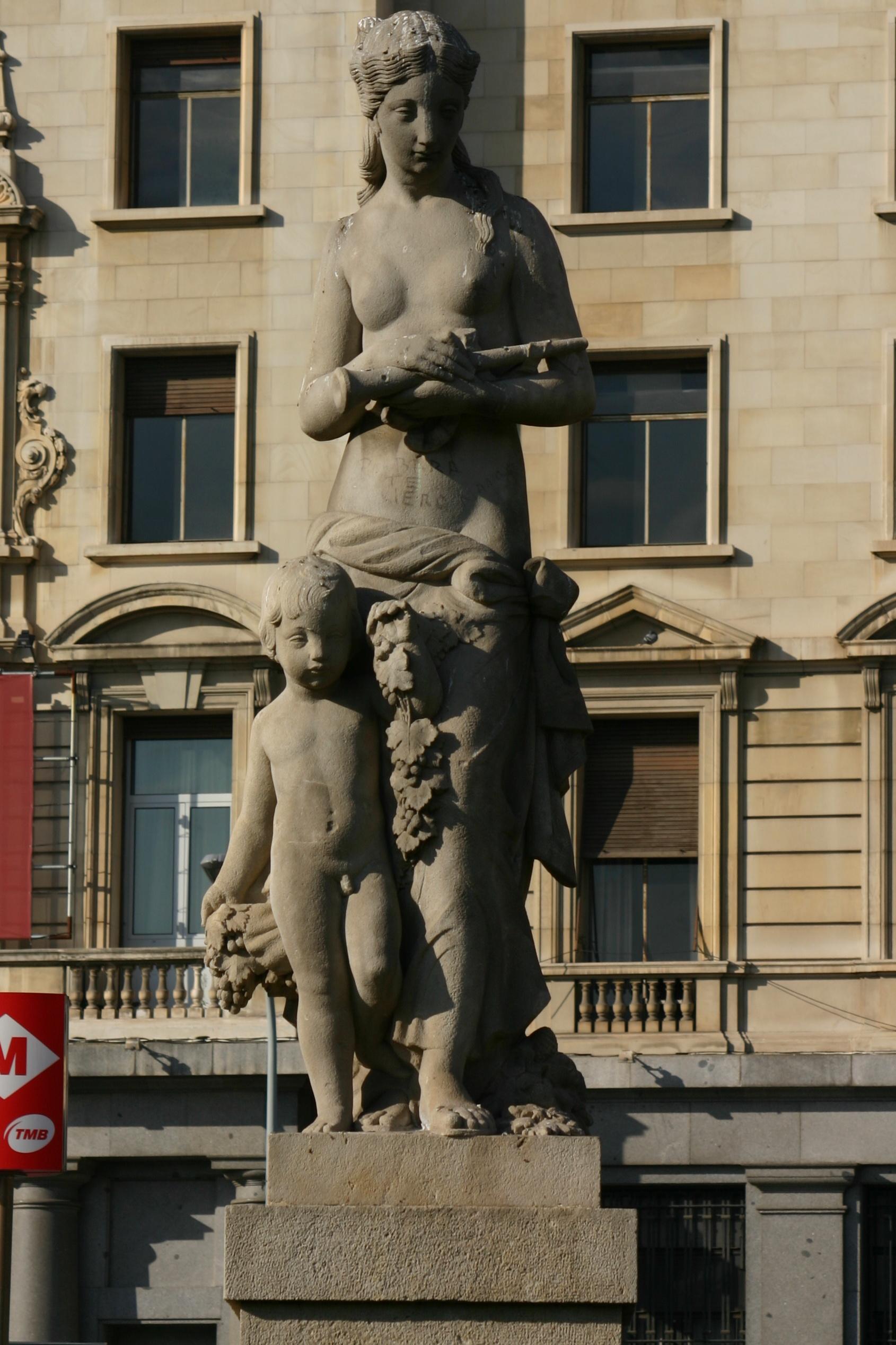
Dona amb nen i flabiol
Dona amb nen i flabiol stands among Barcelona’s public artworks in Plaça Catalunya, presenting a mother and child. Its elongated figures, loose tunic, and pronounced gestures create a stylised outline. The young woman holds a flabiol, while the child carries a vine branch with grapes beside her. A cornucopia rises behind them, adding abundance to the family scene.
Josep Viladomat i Massanas completed the sculpture in 1928, as Barcelona prepared public decoration for the International Exposition of 1929. The young artist carved it from Montjuïc stone, linking the work to the city’s mountain and architecture. Its Noucentisme language joins classical structure with refined baroque influence and long, narrow bodies. Motherhood, music, tradition, and abundance meet through four visible elements. Viladomat later produced monuments and civic sculptures across Catalonia.
The work belongs to a group of Plaça Catalunya sculptures focused on mothers and children. Its smallest details remain the most distinctive: a Catalan flute in one hand and grapes in another.
- City
- Barcelona
- Content updated
Take this page with you
The myTuur app is free, and once you are standing at a spot its story starts by itself.


Spots like this one are the stops myTuur strings into tours through Barcelona. In the app, each story begins where you stand: walk up to a spot and it starts, read it on screen or listen as you go, then follow the route to the next one.
What is myTuur?
myTuur is a free city-guide app. Its tours are built from spots, and each spot carries a story that starts when you get there, to read or to listen to as you like.